
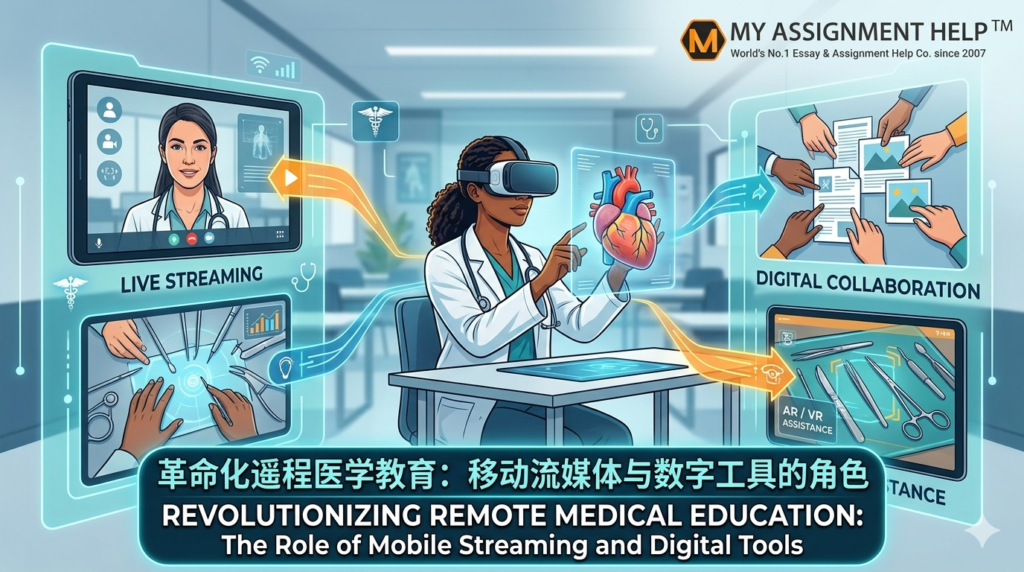
The landscape of medical education is undergoing a seismic shift. No longer confined strictly to anatomy labs and lecture halls, today’s aspiring doctors, nurses, and healthcare professionals are accessing knowledge anywhere, anytime, thanks to the explosion of mobile streaming and sophisticated digital tools. While this transformation has been in motion for years, accelerated by recent global shifts towards remote learning, we are now witnessing a genuine revolution. Medical education is becoming more accessible, interactive, and personalized, leveraging technology not merely as a temporary replacement but as a powerful enhancement to traditional methods.
Historically, medical training relied heavily on intense, in-person instruction, complex textbooks, and localized clinical rotations. While these pillars remain crucial, integrating digital solutions bridges critical gaps in accessibility, particularly for students in rural areas or those with limited financial resources. This shift is particularly evident in fields demanding both theoretical mastery and practical skill acquisition, such as nursing. In the United States, nursing education continues to evolve, incorporating innovative simulation techniques and remote learning platforms. However, the rigors of balancing theoretical knowledge with clinical requirements can be demanding for students. Recognizing these challenges, resources providing nursing assignment help have emerged, helping students navigate complex coursework and clinical documentation, although their primary purpose remains a support mechanism rather than a core educational tool. **
The power of this digital revolution lies in several key areas:
1. The Proliferation of Mobile Streaming and Video Content
Video is no longer passively consumed; it’s an active learning tool. Medical schools and hospitals are increasingly leveraging streaming platforms (both public like YouTube and secure, institutional ones) to broadcast lectures, complex surgical procedures, and detailed patient case studies. This allows students worldwide to learn from leading experts they might otherwise never access.
Furthermore, micro-learning – short, focused video modules – is gaining immense traction. These bite-sized pieces of information are perfect for studying on the go, making efficient use of small pockets of time between clinical rotations or commuting. Studies have indicated that interactive video content significantly enhances knowledge retention compared to traditional reading alone, engaging different learning styles effectively.
2. Immersive Experiences with VR, AR, and Simulation
Perhaps the most exciting frontier is the use of Virtual Reality (VR) and Augmented Reality (AR) in medical training. These technologies offer high-fidelity simulations that allow students to practice complex procedures in a safe, repeatable, and low-stakes environment before they ever touch a live patient. From navigating intricate internal anatomy in 3D to simulating high-pressure emergency room scenarios, these tools provide invaluable hands-on experience remotely.
- Virtual Anatomy: Students can explore the human body layer by layer using VR headsets, enhancing spatial understanding in ways that 2D diagrams cannot match. **
- Procedural Practice: Aspiring surgeons or nurses can refine their skills on virtual patients, receiving immediate feedback on technique and decision-making.
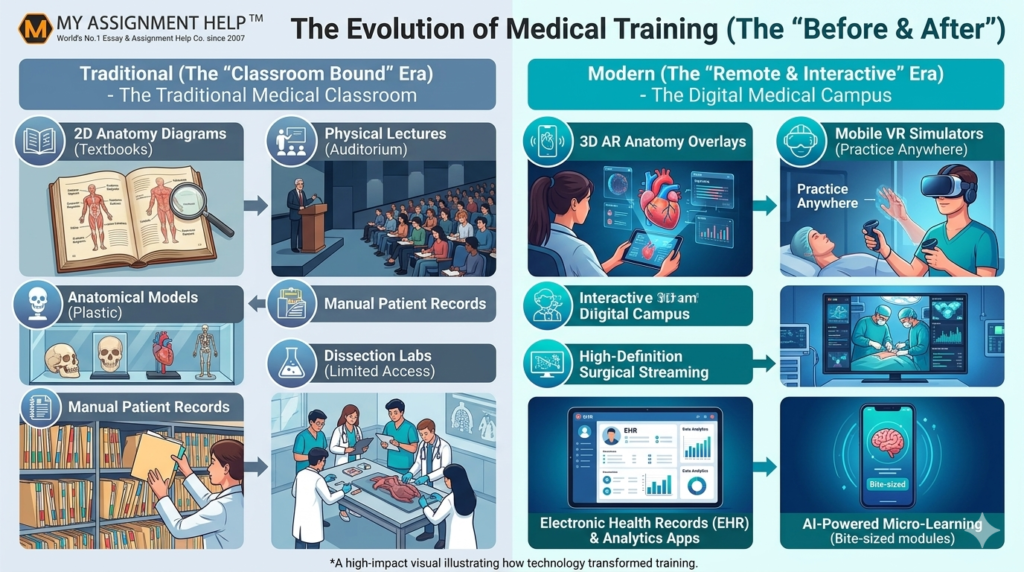
A compelling infographic illustrates this shift:
[Image showing the contrast between traditional medical training methods (anatomical models, dissection labs, physical textbooks) and modern, digital-first training tools (VR anatomy, surgical simulators, streaming lectures, mobile apps, remote patient monitoring systems).]
3. Sophisticated Medical Apps and Reference Tools
Mobile applications have become essential extensions of a medical student’s (and practitioner’s) toolkit. These apps serve multiple functions:
- Point-of-Care Reference: Instant access to drug databases, diagnostic algorithms, and treatment guidelines is crucial in clinical settings. Apps like Epocrates and UpToDate are industry standards, placing vast medical libraries in the palm of a hand. **
- Study Aids and Question Banks: Apps optimized for medical board exams (USMLE, NCLEX-RN) offer interactive flashcards, extensive practice questions, and detailed performance analytics, helping students identify weak areas efficiently.
- Data Visualization and Analysis: Specialized apps can visualize complex physiological processes or help track and analyze patient data, integrating data science skills early into medical training.
Meeting the Academic Demand
The integration of these digital tools dramatically improves learning outcomes and bridges geographic barriers. However, the academic demands placed upon medical and nursing students remain exceedingly high, requiring not only technological proficiency but also rigorous critical thinking and strong communication skills. Navigating challenging coursework alongside hands-on clinical training often prompts students to seek comprehensive academic support or specialized assignment help to manage their intense workload effectively and ensure they are meeting all program requirements. [Image showing a stack of medical books and a laptop with an online course interface]
The transition to a digitally-driven remote medical education model is not without its challenges. Issues around digital equity, data privacy, and the critical need for robust validation of educational content are real. The concept of E-E-A-T (Experience, Expertise, Authoritativeness, and Trustworthiness) is paramount here. Medical content, particularly that used for training future healthcare professionals, must be rigorously vetted by established medical experts and institutions. ** Educational bodies like the Liaison Committee on Medical Education (LCME) and the American Association of Colleges of Nursing (AACN) are actively establishing guidelines and accreditation standards for virtual learning and simulation to ensure quality and safety.
4. Continuous Learning and Professional Development
The impact of digital tools extends beyond initial degree programs. They facilitate lifelong learning and Continuing Medical Education (CME), essential for keeping pace with rapidly evolving medical knowledge and technology. Webinars, online courses, and interactive case discussions on specialized platforms enable healthcare professionals worldwide to stay current, even in demanding schedules.
Looking Ahead: The Personalized Future
The convergence of artificial intelligence (AI) and digital learning tools is poised to personalize medical education further. Adaptive learning platforms can analyze individual student performance, tailoring content delivery to address specific knowledge gaps. AI-powered virtual tutors could provide round-the-clock guidance and feedback on simulations, making medical education more responsive to individual student needs than ever before. **
In conclusion, mobile streaming and digital tools are fundamentally reshaping medical education, making it more dynamic, accessible, and potentially more effective. This transformation is not replacing the need for deep knowledge or compassionate care but providing future healthcare providers with powerful, modern means to acquire and refine the critical skills they will use throughout their careers. As technology advances and E-E-A-T standards evolve alongside it, we can expect remote medical education to continue its revolutionary trajectory, ultimately leading to better-prepared clinicians and improved patient outcomes globally.
Key Takeaways
- Mobile streaming and digital tools are revolutionizing medical education by enhancing accessibility, interactivity, and personalization.
- The use of video content, micro-learning, and simulations (VR/AR) improves knowledge retention and provides safe environments for practical skill acquisition.
- Medical apps serve as essential reference tools and study aids, aiding both theory and practice in fields like nursing and medicine.
- The integration of digital tools increases access for students in remote areas and supports lifelong learning (CME) for practicing professionals.
- Upholding rigorous E-E-A-T (Experience, Expertise, Authoritativeness, Trustworthiness) standards for all digital medical content is crucial for quality assurance and patient safety.
- Academic support services, including assignment help, can assist students in managing the intense workload associated with modern medical and nursing programs, though they serve as a support mechanism, not a core learning tool.
Frequently Asked Questions (FAQ)
1. Can digital tools and remote learning completely replace traditional, in-person medical education?
While digital tools offer significant enhancements and allow for substantial remote learning, certain aspects of medical education, such as hands-on patient interaction and specific physical examination techniques, still benefit greatly from in-person instruction and clinical rotations. A blended approach, leveraging the strengths of both methods, is widely considered the most effective model.
2. How do I know if the digital medical content I’m using is reliable and authoritative?
Prioritize content from reputable medical institutions, universities, established medical journals, and professional organizations (e.g., AACN, AMA). Look for content that is explicitly peer-reviewed or created/vetted by recognized medical experts. Check for disclosures regarding authorship and funding sources to assess potential biases. The principles of E-E-A-T are essential here.
3. Are specialized apps like those for anatomy or drug references useful for non-medical students or the general public?
Yes, many medical apps have versions or features suitable for a general audience interested in health education. However, it’s crucial to understand that apps designed for professional medical reference provide much greater detail and complexity, and their use in making diagnostic or treatment decisions should only be done under the guidance of a qualified healthcare professional.
4. What are the key skills medical students need to succeed in a digitally driven remote learning environment?
Beyond core medical knowledge, students must develop strong digital literacy, time-management skills to navigate self-paced learning, critical thinking to evaluate digital content quality, and effective online communication skills for collaborating with peers and instructors remotely.
References & Data Sources
- American Association of Colleges of Nursing (AACN). (2024). The Essentials: Core Competencies for Professional Nursing Education. [Focuses on the integration of digital literacy and simulation in BSN programs].
- Liaison Committee on Medical Education (LCME). (2025). Functions and Structure of a Medical School: Standards for Accreditation of Medical Education Programs. [Details the shift toward virtual and remote learning equivalence].
- National Library of Medicine (NLM). (2025). The Impact of Virtual Reality and 3D Simulation on Anatomy Learning Outcomes: A Meta-Analysis. Journal of Medical Education Technologies.
- U.S. Department of Education, Office of Educational Technology. (2024). Reimagining the Role of Technology in Higher Education: 2024 National Education Technology Plan Update.
- Journal of Nursing Regulation. (2025). National Simulation Study: The Longitudinal Impact of Replacing Clinical Hours with High-Fidelity Simulation in Nursing Education.
- Statista Health & Pharma Reports. (2026). Global Mobile Health (mHealth) Market Size and Forecast: Focus on Medical Education Apps (2023-2030).
- HIMSS (Healthcare Information and Management Systems Society). (2025). Digital Health Transformation: Trends in Remote Medical Training and Telehealth Integration.
Author Bio:
Sarah Chen is a seasoned Content Writer at MyAssignmentHelp with over seven years of experience in the higher education and edtech sectors. Possessing a deep understanding of the unique challenges and opportunities within healthcare education, particularly nursing and allied health programs, she is passionate about exploring the intersection of technology and pedagogy. She strives to produce informative, well-researched content that adheres to high standards of expertise and trustworthiness (E-E-A-T), helping students and professionals stay informed about critical developments in their fields. Outside of writing, Sarah enjoys hiking, volunteering with local healthcare initiatives, and exploring innovative digital learning platforms.